For centuries, we have been astounded by the physical and biological world we inhabit and how it exists within a delicate, almost perfect, balance of forces. The Earth sits at a precise distance from the Sun that makes our atmosphere neither too hot nor too cold, allowing water to remain liquid and marine and land-based life to flourish. The natural world is further influenced by the Earth’s 23.5° tilt, which shapes the seasons across all continents, and dictates when landscapes transition from the heat of summers, or the green abundance of monsoons, to the cold darkness of winter. Even the Moon, circling beyond our atmosphere, exerts a gravitational pull so strong that it moves billions of litres of ocean water every day.
These are the fundamental, omnipresent and objective mechanics of our world, and for those who work closely with nature, they are practical tools, not mere concepts or speculations. Aligning human behaviour and collective activities with these outer-planetary rhythms and cycles is an ancient science. Throughout history, civilizations like the Aztecs in South America and ancient people of Greece and the Indian subcontinent tracked the movements of the Sun, Moon, and planets with mathematical precision to guide their daily lives. They, for example, understood that different lunar phases signalled shifting gravitational pulls on the water, but also on the soil.
Today, this awareness remains in industries that depend on working with the elements. Fishing boats and trawlers, for example, align their harvest periods with lunar cycles because they know the Moon governs the tides, and by extension, the movement of large schools of fish and other marine animals. Farmers are no different; for centuries, they have aligned the timing of their harvests, their ceremonies, and their labour and practices in the field to these phases to ensure their work is assissted by natural forces.
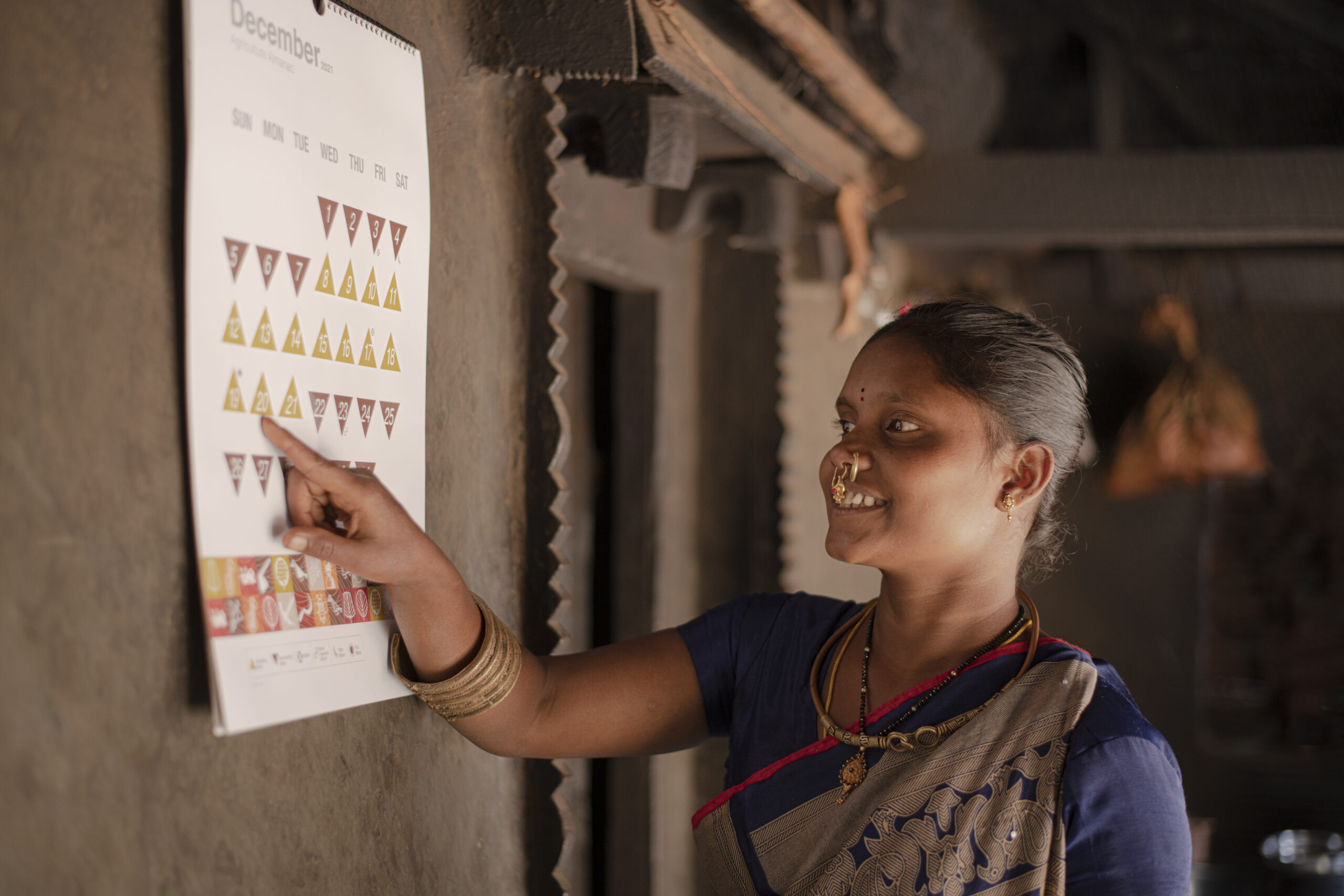
Modern agriculture, which prioritises using chemical products and machines to grow large volumes of staple food, completely overlooks these natural patterns as technologies in themselves to be harnessed for improved agricultural outcomes in terms of soil health and yields. To preserve and show respect for the knowledge of these natural patterns, and what is possible when we leverage them, Naandi created an agriculture Almanac for the farmers who have adopted our form of organic-regenerative agriculture, which we define as a movement towards soil health, diverse farms and ecosystems, and healthy, nutritious food for all. This Almanac acts as a daily guide, helping farmers align their tasks in the field—like sowing seeds, planting saplings, using bio-inputs, and harvesting—with the specific rhythms of the Moon and planets.
Translated into ten languages and using beautiful, intuitive symbols, the Almanac tracks key astronomical related to phases and the positions of the Moon, the Sun, and Saturn.
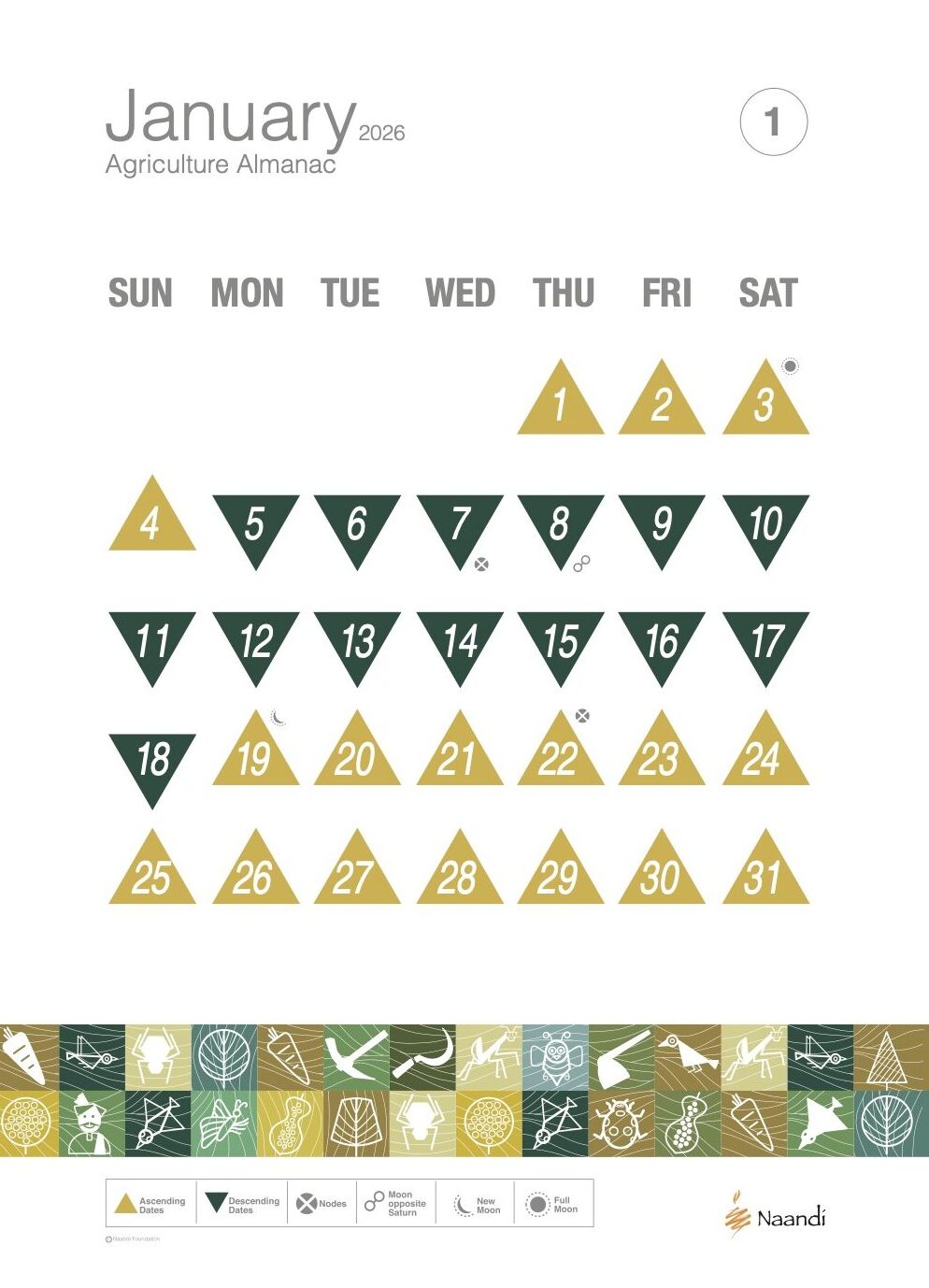
The physical mechanics to first understand are the ascending and descending phases of the Moon. These phases exist because the Moon’s path around the Earth does not lie on a flat or horizontal 180-degree plane. In reality, the orbit is tilted by about 5 degrees, and this creates a two-stage cycle. The first is where the Moon “climbs” in an upward arc, travelling from the south to the north of the Earth during its orbit. Conversely, in the descending phase, the Moon “falls,” orbiting in a downward arc from north to south of the Earth. You can easily determine these phases yourself by tracking the Moon’s highest point in the sky; if that peak rises each night, the Moon is ascending, and if it lowers, the Moon is descending.
In the ascending phase, the Moon confers an upward gravitational force (a pull) on the Earth’s surface, affecting both soil and water. This force intensifies growth-related biological processes, such as photosynthesis which fuels upwards and outwards growth of stems/trunks and leaves. On these days, the Almanac suggests tasks related to growth and harvesting, such as sowing seeds, harvesting crops, and applying W100 leaf treatments in the early morning. In the descending phase, the Moon exerts a downward gravitational influence (a push) that stimulates soil-based vitality. This enhances the metabolism and migration of earthworms and microbes, while encouraging roots to anchor deeper into the sublayers of the Earth. Here, the Almanac guides farmers to focus on the soil-based activities: spraying B100 soil fertility primer, transplanting saplings to establish strong roots, and harvesting root crops.
Moving onto the Full Moon, a night often celebrated with local ceremonies. On these luminous days, farmers are guided to sow seeds and carefully inspect their crops for pests. In contrast, the New Moon, when the Moon vanishes from the night sky completely, is a time for the farmers themselves to retreat from the fields. The Almanac advises abstaining from agricultural work during this time to allow the land a moment of necessary quiet and stillness. This same period of rest is required during Nodal positions, occurring when the Moon, on its tilted path, crosses the horizontal ecliptic plane, which you can imagine as Earth’s horizontal orbital path around the Sun.
Finally, the Almanac marks the days in the position ‘Moon opposite Saturn’. This alignment occurs when the Earth sits directly between the Moon and Saturn. It creates a unique state of balanced gravitational tension, harmonising growth processes both above and below the soil. This is considered a premier window for nearly all agricultural activities, particularly planting, transplanting, and soil priming with bio-inputs like B100 and C100. The Equinoxes and Solstices, marking the onset of seasons, are also shown by the calendar.
The Almanac portrays these phases and lunar and planetary positions effectively using bold, intuitive shapes alongside decorative motifs of flora and fauna found on a farm. To ensure clarity, the symbols follow a visual logic: ascending and descending Moon days are represented by upward or downward pointing triangles, while the full and new Moon days are indicated with a filled circle and a simple sliver, respectively. By using this illustrative key, the complex science of astronomy becomes accessible to all farmers, regardless of their literacy level. We view the Almanac as a blend of science and art (much like agriculture). It is a visual guide to tracking the passage of time and the movements of planets in the sky, provided in a language that everyone can read and interpret.
When farmers choose to work with us and adopt our model of organic regenerative agriculture, they receive bio-inputs, compost, and training, alongside this Almanac. By providing these resources together, we reconnect smallholding farmers with the knowledge of natural rhythms and encourage them to align their field practices with these rhythms to maximise biological outcomes of healthier crops, and more abundant, timely harvests.
To all the farmers in our programmes: thank you for your work, your intuition, and your partnership in keeping the culture of agriculture and the awareness of seasonal rhythms alive.